A Few of my Favorite Books: Paul Galdone


(Affiliate links included for your convenience)

Despite the fact that I’m a Montessori teacher, I still have a deep love for fairytales and folktales and frequently enjoy sharing these classic stories with my students. My all-time favorite author and illustrator of classic fairytales is Paul Galdone.


His books usually use concise to-the-point language, which is great in special education (i.e. I don’t usually have to drastically modify the story as I read so that my students will understand). And his illustrations are beautiful,  and enhance student comprehension of the story (I hate when the illustrations don't do much for understanding the story!)

Here are a few of my favorite Paul Galdone books:

Goldilocks and the Three Bears

The Three Billy Goat’s Gruff

The Little Red Hen

Three Little Kittens

The Gingerbread Man

Jack and the Beanstalk


I will give a little warning and suggest that you preview his books before reading them aloud so that you're not surprised by the content and/or storyline - specifically Jack & the Beanstalk! While I still love this book, his version includes the giant drinking lots of wine and passing out... I do tend to skip over this part!


Literacy Centers: Secret Message Activities

My own son was struggling with learning his sight words AND he absolutely hated practicing! So, I started brainstorming fun ways for him to practice his words...

We tried many different ideas from building words with letter magnets to rainbow writing to making them with pipe cleaners... By far, his absolute FAVORITE way to practice words was this Secret Message activity:


Here's how it works:

1. Print & Prep - There isn't really too much to do to get this activity ready. Simply print the word cards on white card stock, laminate for durability and cut the cards out. The cards MUST be printed in color for the activity to work!

2. Make or Buy a Decoder - Instructions for creating a decoder window from dollar store materials is included; all that you'll need is cards stock, glue, scissors and red cellophane. If you don't have time to make a decoder (or maybe you're not very crafty?), it's also possible to either set up an iPad or iPhone to use as a decoder or purchase a decoder pretty cheaply.


3. Choose a Worksheet - Choose and print the recording sheet that is most appropriate for your students. There are many differentiated options as well as a blank option to be used with any set of 10 word cards from the pack.

4. Set Up & Teach the Center - The activity can be set up as either a Write the Room activity or a stationary literacy center; you decide what's best for you students! Show your students how the activity works; they'll catch on quickly and will actually be eager to read the hidden words!


Here's a clip of my son practicing his words in the dark before bed using a little red LED flashlight keychain as the decoder:


Still not sure about this activity? Try this Secret Message Sight Words SAMPLE pack that includes 10 Fry sight words and the recording worksheets. It's perfect for a mini literacy center!


Find other Secret Message literacy activities HERE:


Here are some of the things you might need in order to make or buy a red filter decoder: 


Montessori on a Budget


Even if you’re a Montessori newbie, I’m sure that you already know that starting Montessori classroom or homeschool program can become pricey very quickly! Authentic Montessori materials are made from high quality and sturdy materials, making them a somewhat hefty investment right up front. Some materials can be homemade relatively easily if you have a little skill with some paint, glue and sandpaper, while other materials take a bit more elbow grease and a moderate skill set with power tools. I’m not especially skilled with power tools, but know my way around the craft store pretty well and can spray paint just about anything!

In addition to classic Montessori materials that make up the foundation of a Montessori program, a variety of other materials are needed to supplement and deepen the opportunities for learning. Supplemental materials can be purchased from companies providing Montessori materials, but often at a high cost. In my experience I’ve found that many supplemental items can be purchased cheaply from thrift stores, big box stores, yard sales and other less obvious sources if you can think creatively!

Check out my favorite was to Montessori on a Budget:


Dollar Store Montessori: Top Ten


Even if you're new to Montessori, you probably quickly realized that Montessori isn't cheap! I'm always on the look out for items to use in my classroom and finding things that don't break my bank account are awesome! Here are my top ten Montessori items that I usually find at my local dollar and discount stores. 


1. Plastic Trays - The dollar store usually has tons of different tray options that are perfectly sized for young children to hold and carry. Since many Montessori activities are presented on individual trays, it’s important to have lots of trays available. I also like to color coordinate with seasonal themes, so when I find a try that I LOVE, I usually buy several of each in every color that they have (ugh!). Look for clear plastic trays in the party section and colored plastic trays in the kitchenware section.

2. Plastic Baskets - While I personally love natural baskets, I simply cannot find enough of the same basket at a low price to effectively organize materials, especially in the language area. Dollar stores often carry a large selection of  plastic storage containers and colored plastic baskets that are perfect for organizing language materials and math manipulatives.

3. Plastic Bowls - I’ve had a difficult time finding large enough plastic bowls for mixing, washing and scrubbing activities or have found containers that are large enough, but were way to pricey for me to purchase. I’ve luckily found some very large bowls, buckets and basins in multiple colors at dollar stores near my school.

4. Small Glass Bowls-  I use tons of small bowls to hold various manipulatives when setting up tray works. I’ve found several size variations of small glass bowls in the kitchenware section and they usually come in packs of 3 or 4 at a time which is perfect when we accidentally break a few each month.

5. Colored Sand - In the floral section, I frequently find colored sand in small bags which is perfect for my sand writing tray. I switch out the color of sand about once a month – sometimes I add glitter to the sand to make it more fun.


6. Napkin Holders - I am fully aware that this seems like kind of an odd item to have on my list, but really the small plastic napkin holders are perfect for holding extension worksheets or recording pages right next to the activity. They hold the papers upright and keep them neat and organized.

7. Tweezers/Tongs/Grabbers - There are so many different variations on the tongs/tweezers and grabbers that are available. I’ve consistently found sets of several types of tweezers in the health and beauty section as well as various size tongs in the kitchenware section. On occasion, I’ve even been lucky enough to score chopstick like grabbers in multiple colors!

8. Manipulatives - The dollar store is a great place to find a variety of manipulatives for tray works from dry rice or beans to tiny erasers and craft materials. Super for practical life and math centers! I recently found plastic 'gems' in several different colors... 

9. Sponges & Cleaning Supplies- Since every wet work needs a sponge, I'm always looking for a variety for colors to match to my works - I've found great variety in colors at dollar stores and you often get 2-4 sponges for only $1. I've also been lucky enough to find small dust pans and brushes, scrub brushes and dish brushes in multiple styles, shapes and colors which are perfect for many practical life works. 

10. Seasonal Items - Since I switch out my trays monthly and follow seasonal holidays and trends, I'm constantly on the lookout for seasonal specialty items that can be pretty pricey at other stores. I stock up on seasonal 'party favors,' and small decor items for use in various classroom activities. I recently purchased several different types of Easter eggs, easter grass, small blue eggs and some flower shaped gems that will be useful in my practical life and math activities in the coming weeks.
BONUS Idea - 
11.  Unique Containers - I have a basket of various containers for opening, closing and putting small objects in and out of as a fine motor activity. I'm always on the lookout for interesting little containers to keep this activity new and exciting for my students. I've found so many small containers that open in a variety of ways at the Dollar Store - check out the seasonal candy section for little tins, seasonal shaped containers and interesting boxes. The health and beauty section also has many options. And look for coin purses and little zipper bags near the makeup or by the checkouts.


Budget Montessori: Thrifting Montessori


I love walking around thrift stores and enjoy the excitement of finding a real treasure every once in a while.  Since I’m already in the habit of strolling around thrift stores, I'm naturally always on the look out for items to use in my classroom. Here are a few of the things that I keep my eyes open for:

1. Baking Pans – Baking pans come in a wide variety of sizes, quantities, shapes and materials. Look for smaller muffin pans, silicone baking pans and shaped cake pans.


2. Trays – I never seem to have enough trays in my classroom, so I’m always on the lookout for cheap or interesting trays to add to my collection. I really love bamboo trays and frequently find them at thrift stores for way less than they'd cost online or at Pier One!

3. Baskets – Again, I’m always in need of storage in my classroom and baskets are a great option! I keep my eye out for heavy duty rectangular baskets used with casserole dishes, large baskets for blocks and small baskets for little pieces. 

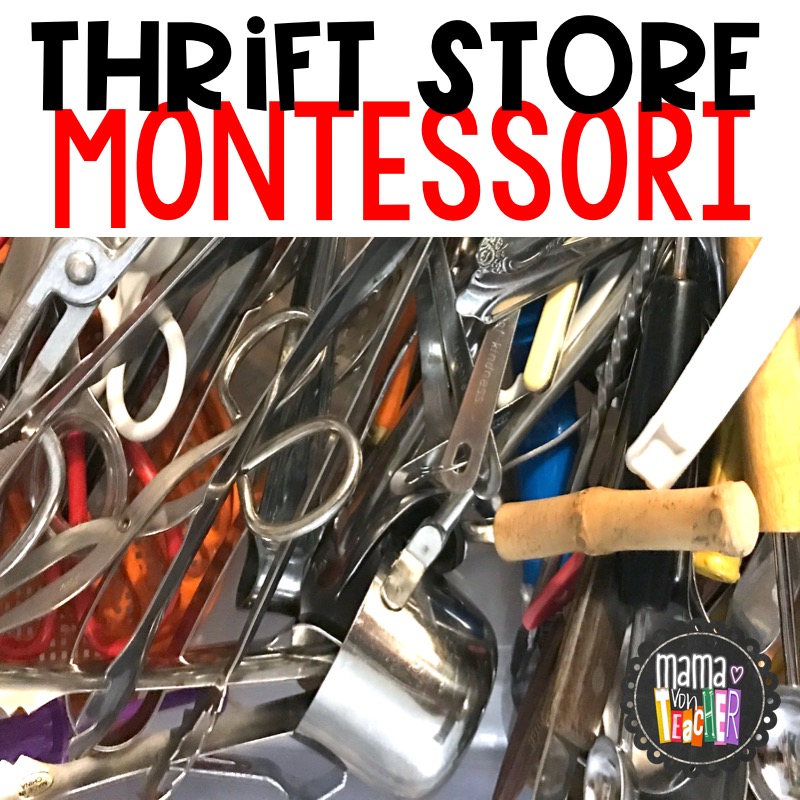
4. Utensils - whisks, spoons, cheese knives, juicers, melon ballers, hand-crank eggbeaters, citrus juicers, garlic presses, hand-crank food mills... the list of options goes on and on.


5. Candy Molds – Candy molds are usually made from clear plastic and come in a HUGE variety of shapes and sizes. I just recently started noticing these little plastic molds are pretty popular at the thrift store and are so cheap. I use them with colored water & droppers or with play dough.

6. Cookie Cutters – I rotate my collection of cookie cutters through our classroom during the year and I’m always looking for new ones. Small cookie cutters work great on trays with play dough. They can also be traced, dipped in paint and stamped and used with sand or dirt.

7. Teapots/Creamers/Pitchers -  Since I frequently switch out my pouring activities, I like to have lots of options to keep it fresh. The thrift store is great for finding lots of cheap little creamers, pitcher and teapots. I once even found a cute little sake set for pouring! 

8. Silver, Brass & Wooden Knickknacks – for polishing

9. Ice Cube Trays – all shapes and sizes! I have a growing collection of ice cube trays in a wide variety of shapes, sizes and colors that are perfect for tweezing, tonging, transferring and one-to-one correspondence activities.


10. Musical Instruments - Look for bells, wind chimes, drums... etc.

BONUS Ideas!

11. Books - Thrift stores are a great place to find lots of amazing books for a great price. Don't forget to look beyond the kid's book section for great non-fiction books about plants, animals and other topics. Check out my post about finding cheap books HERE for more ideas!

12. Toys & Games - I've found so many great games for my classroom in the toy section of my local thrift stores. It seems that the more educational games that are perfect for classroom use turn up at the thrift store often - maybe they weren't a hit at home!